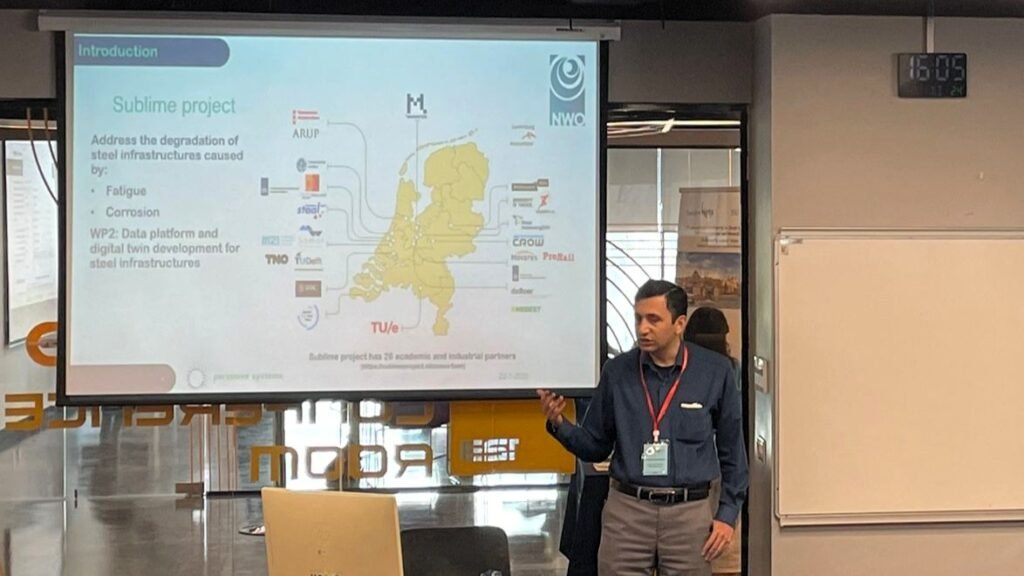
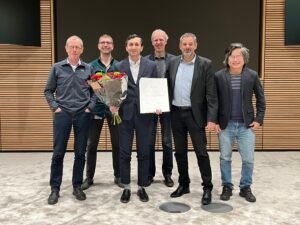
The SUBLIME consortium is proud to share that Ali Sabzi Khoshraftar, EngD researcher at the University of Twente’s Pervasive Systems Research Group, presented his latest research at the IEEE SmartNets 2025 conference. The conference took place from 22-24 July 2025 and hosted by Istinye University, Turkey, and brought together global experts in digital systems, monitoring technologies, and smart infrastructure. Ali’s paper, titled “Digital Twins for Bridge Assessment and Maintenance,” addresses a critical challenge faced by asset managers worldwide: how to efficiently and accurately monitor and maintain an aging stock of bridges in a safe, cost-effective, and environmentally conscious manner. Developed as part of Work Package 2 of the SUBLIME project, his work introduces a reference architecture for a predictive digital twin (DT) system tailored specifically for steel bridge maintenance. Read more on the M2i website

CT de Boer Showcases SUBLIME Fieldwork at the 2025 M2i Conference
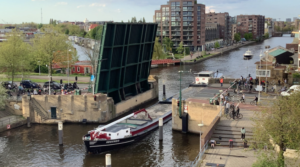
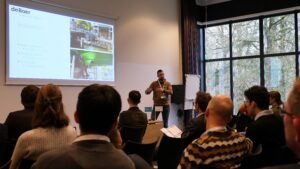
During the 2025 M2i Conference at Papendal, Anton Gorter of Civiele Technieken de Boer presented the progress of SUBLIME’s field monitoring work on the Van Hall Bridge in Amsterdam. His talk, “An on-site measurement campaign – it sounds so simple” highlighted the many practical steps and unforeseen challenges involved in collecting high-quality strain data on a historic movable steel bridge.

Sheet Pile Corrosion Study Begins
The SUBLIME project is taking a major step forward in understanding how steel sheet piles age in real port conditions. In close collaboration with North Sea Port (NSP), TU Delft researcher Prasaanth Ravi Anusuyadevi is preparing the installation of a new field-testing structure that will allow long-term monitoring of corrosion processes on S355 steel.
Following recent discussions between TU Delft and NSP, both partners agreed to install a dedicated sample-carrying structure directly in the port. The design includes three identical frames, each hosting nine steel samples and each intended for different exposure durations: 3 months, 6 months and 1 year. The samples will be positioned at different depths along the waterline to capture how corrosion varies from splash zone to full immersion.

Smarter Cameras from Fewer Views — A Sparse-View Pose Estimation
How do you recreate a 3D scene using just a few pictures from different angles? That’s a challenge many fields face — from drone-based inspections to 3D mapping for remote sensing or structural health monitoring. Qingyu Xian, PhD researcher at the University of Twente, is tackling this challenge head-on in the SUBLIME project with a novel tool that’s already showing strong results: the T-Graph module.