
N21007a: Structural degradation monitoring and prediction: fatigue
Market: Advanced Metals
Many steel bridges across Europe are reaching the end of their intended service lives, raising critical questions about how to assess and extend their safe use. Within the SUBLIME program (“Sustainable and Reliable Macro Steel Infrastructures”), our mission is to ensure that these critical structures remain safe, sustainable, and serviceable for decades to come. One of the program’s key objectives is developing smarter assessment tools that help us better understand the condition of ageing steel — particularly when data is limited. That’s where the work of Elena Zancato, PhD researcher at Eindhoven University of Technology (TU/e), comes into focus.
Elena’s research, conducted within the scope of SUBLIME, targets a long-standing challenge: how can we accurately estimate the fracture toughness of old steel structures, like bridges, when only a few physical tests on bridge can be taken? Her answer lies in combining rigorous data analysis with modern Bayesian statistics — reducing uncertainty without increasing invasive testing.
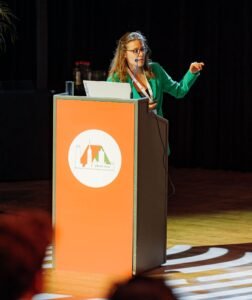 Her recent study, presented on the 28th August at the IABSE 2025 Congress in Ghent, proposes a Bayesian framework for updating fracture toughness estimates based on minimal test data. It’s a tool developed with engineers and asset managers in mind, particularly those responsible for assessing large steel structures where destructive testing is costly or impractical. By merging prior knowledge from a Dutch and European steel bridge database with new test results, Elena’s method delivers improved fracture toughness estimates that are both practical and reliable.
Fracture toughness is critical for predicting fatigue life. Older steel bridges often exhibit greater variability and uncertainty in material behavior, which increases the risk of failure. However, standard methods for assessing fracture toughness require more data than is usually available in field conditions. Elena’s Bayesian approach explores two complementary strategies for updating fracture toughness estimates — one aligned with practical engineering applications and another that adheres to formal standards. While both approaches help reduce uncertainty, a direct comparison between them was limited by the characteristics of the statistical index used..
Her simulations show that even with just three tests, confidence in material performance improves. Six or eleven tests improve it further — but crucially, the Bayesian method reaches stable, reliable results long before conventional methods would. For the SUBLIME program, this translates into real benefits: faster, more cost-effective assessments with less disruption to structures in use.
To evaluate the value of additional test data, Elena used the Kullback-Leibler divergence — a statistical measure of how much new data shifts predictions. The results showed that even a small number of tests — as few as 3, 6, or 9 — already delivers a substantial reduction in uncertainty compared to using no data. While the analysis indicated diminishing returns beyond 30 tests, the early gains highlight the value of limited testing in real-world scenarios. This insight supports SUBLIME’s vision of targeted, efficient testing rather than exhaustive sampling.
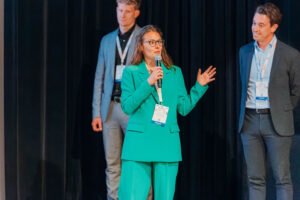 Her research also explored different ways to model uncertainty. For Method 1, she was able to quantify how increasing test data from 3 to 6 and 11 samples reduced uncertainty by 17.5% and 25.9%, respectively. Due to high computational costs, a similar analysis wasn’t feasible for Method 2. While stricter filtering can improve precision, flexible statistical assumptions may offer practical advantages, especially when only limited data are available. . These kinds of findings help SUBLIME refine best practices and inform future guidelines for infrastructure assessment.
Ultimately, Elena’s work strengthens the tools available to structural engineers and asset managers across the SUBLIME network. It’s a powerful example of how academic research, when grounded in real-world constraints, can directly inform practice.
“Being part of SUBLIME allows me to focus on challenges that really matter to infrastructure safety,” says Elena Zancato. “My goal has been to create a tool that works with the data limitations engineers face on site. It’s exciting to see our approach already making structural assessment more accessible.”
This work is part of the SUBLIME program and was carried out under project KICH1.ST01.20.008funded by the Dutch Research Council (NWO) and supported by M2i under N21007a. For more information, please read: DOI: https://doi.org/10.2749/ghent.2025.0226
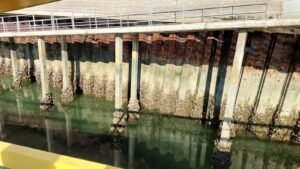
Sheet Pile Corrosion Study Begins
The SUBLIME project is taking a major step forward in understanding how steel sheet piles age in real port conditions. In close collaboration with North Sea Port (NSP), TU Delft researcher Prasaanth Ravi Anusuyadevi is preparing the installation of a new field-testing structure that will allow long-term monitoring of corrosion processes on S355 steel.
Following recent discussions between TU Delft and NSP, both partners agreed to install a dedicated sample-carrying structure directly in the port. The design includes three identical frames, each hosting nine steel samples and each intended for different exposure durations: 3 months, 6 months and 1 year. The samples will be positioned at different depths along the waterline to capture how corrosion varies from splash zone to full immersion.

Smarter Cameras from Fewer Views — A Sparse-View Pose Estimation
How do you recreate a 3D scene using just a few pictures from different angles? That’s a challenge many fields face — from drone-based inspections to 3D mapping for remote sensing or structural health monitoring. Qingyu Xian, PhD researcher at the University of Twente, is tackling this challenge head-on in the SUBLIME project with a novel tool that’s already showing strong results: the T-Graph module.
Researchers Get-Together-Day at DDC
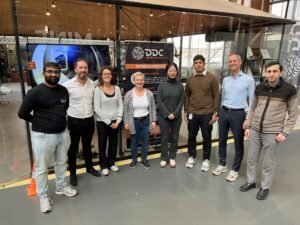
On 9 October 2025, researchers from the SUBLIME project came together to explore how digital twins and drones can make our steel infrastructures more sustainable and reliable. The Get Together Day featured visits to the Dutch Drone Company (DDC) and the RDM innovation campus in Rotterdam — connecting research with real-world innovation and strengthening collaboration within the SUBLIME community.