
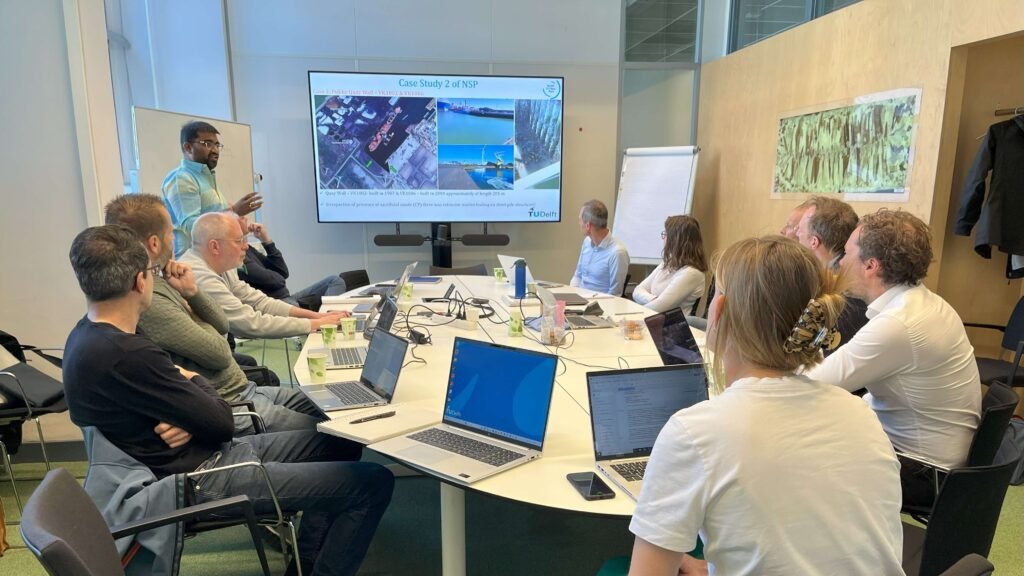

On May 9th, partners of the SUBLIME project gathered at Materials Science and Engineering (MSE) Department at TU Delft, to discuss progress and current challenges in monitoring and modelling corrosion in steel sheet pile structures. The session brought together a group of experts from TU Delft, TU Eindhoven, RHDHV, Province of South Holland (PZH), North Sea Port (NSP) and other key stakeholders (M2i and NWO), all committed to increasing the durability and reliability of Dutch infrastructure.
Corrosion in Focus: A Shared Challenge
The meeting focused on two distinct regions: the North Sea Port, where sheet piles are over 20 years old and protected by sacrificial anodes, and PZH, where newer structures (around 6–7 years old) rely on Impressed Current Cathodic Protection (ICCP). In the first case, despite these cathodic protection systems, significant corrosion has been detected, especially in the low-water and tidal zones—areas due to suspected microbial induced activity. International case studies from the UK, Spain and Japan confirm that this issue is widespread.
Monitoring Gaps and Technological Opportunities
Currently, inspection routines include visual checks above water level (2–3 times annually) and diver-based thickness measurements below water roughly less frequently. However, the last recorded comprehensive data set dates back to 2017 for NSP. To bridge this gap, the team is exploring advanced methods such as drone inspections, satellite imaging and modern sensors. These tools promise more frequent, safer and non-contact ways to assess the condition of sheet piles.
A New Modelling Approach
A core ambition of the SUBLIME project is to develop predictive Digital Twins that integrate both structural models and data. During the meeting, researchers outlined a two-step modelling strategy: (1) translating corrosion into deformation and (2) assessing how deformation accelerates failure. This iterative method will rely on a Bayesian framework to manage uncertainties and perform simulations using a reduced set of key parameters. The ultimate goal is to better predict remaining service life and guide timely maintenance.
Real-World Case Studies Highlight Urgency
TU Delft researcher Prasaanth Ravi Anusuyadevi presented updates on selected study sites:
- Provincial road N211, completed in 2018, will serve as a baseline because no corrosion measurements have yet been carried out. An initial inspection round is being scheduled.
- Quay walls VK0805, VK1002 and VK1006 (North Sea Port) have been identified as early adopters for the modelling workflow. Localised thinning and marine growth have been mapped and cathodic‑protection performance is being assessed.
Next Steps
The team agreed on a clear path forward:
- Prioritize North Sea Port for detailed modelling.
- Consolidate material data and confirm initial conditions for model calibration.
- Prepare for the deployment of sensors and new inspection rounds.
- Develop a finite element model of the structure, accounting for multiple runs with uncertain variables.
- Involve structural engineers to refine uncertainty estimations.
The next consortium meeting is scheduled for July 7th, from 15:30 to 17:00 (online).
By improving how we assess and predict the performance of steel infrastructure, SUBLIME continues to support the transition toward safer, more sustainable and circular asset management in the Netherlands.

Pioneering the Future of Bridge Maintenance: Highlights from the SUBLIME Digital Twin Workshop
On March 21, 2025, the SUBLIME project consortium gathered for its 2nd Annual User Committee Meeting. Hosted by North Sea Port (NSP) at its Vlissingen premises, the meeting brought together over 30 representatives from research institutions, industry partners, government bodies, and funding agencies to reflect on progress, share research outcomes and explore pathways for future collaboration.
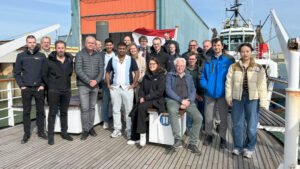
The day featured presentations from PhD and EngD researchers, discussions on key user cases and a site-specific boat tour through the North Sea Port, highlighting the real-world relevance of the project’s themes—fatigue, corrosion, digital monitoring and infrastructure sustainability.
SUBLIME Project Explores Structural Reliability and Innovation at 2nd Annual User Committee Meeting
On March 21, 2025, the SUBLIME project consortium gathered for its 2nd Annual User Committee Meeting. Hosted by North Sea Port (NSP) at its Vlissingen premises, the meeting brought together over 30 representatives from research institutions, industry partners, government bodies, and funding agencies to reflect on progress, share research outcomes and explore pathways for future collaboration.
The day featured presentations from PhD and EngD researchers, discussions on key user cases and a site-specific boat tour through the North Sea Port, highlighting the real-world relevance of the project’s themes—fatigue, corrosion, digital monitoring and infrastructure sustainability.

Introducing Lotte Gerrits – New NWO Representative for SUBLIME
We are pleased to welcome Lotte Gerrits as the new NWO program officer for the SUBLIME project.
Lotte joined NWO in January 2025 after working as a postdoctoral researcher at Radboud University, where she also obtained her PhD in chemistry. With her background in research, she brings valuable expertise and a strong connection to the NWO organization.

