WP3 Progress Meeting and Workshop on Sustainable and Reliable Steel Infrastructure

LinkedIn
Email
Twitter
Telegram
WhatsApp

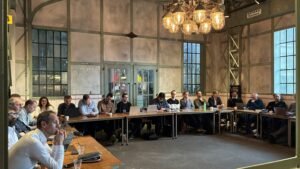
On 11 September 2025, the SUBLIME consortium gathered at Leiden University for a dedicated progress meeting and workshop of Work Package 3 (WP3). The session, hosted in the Van Steenis Building, brought together researchers and industrial partners to discuss ongoing work on life cycle assessment (LCA), governance, and the socio-technical dimensions of sustainable and reliable steel infrastructure. With presentations from PhD researcher Faysal Tareq (Leiden University, CML), Mic Barendsz (Bouwen met Staal), and a hands-on interactive workshop led by Dr. Mohammad Hamida (TU Delft), the meeting provided both scientific insights and space for reflection on real-world challenges.

WP3 in SUBLIME focuses on LCA, socio-institutional analysis, and governance frameworks for steel infrastructure. These perspectives complement the technical work of WP1 and WP2 by considering how materials, actors, and institutions shape the long-term sustainability and reliability of bridges, sheet piles, and other large-scale steel structures.

In his opening remarks project leader Prof. Johan Maljaars welcomed participants and highlighted recent progress in the project. He noted the successful installation of sensors on the Van Hall Bridge in Amsterdam, supported by the municipality of Amsterdam, Arup, CT de Boer, and Somni, and advances in modelling work for the Moerdijk Bridge, supported by RWS and Witteveen and Bos, and sheet pile use cases, supported by NSP, Province South Holland, and Haskoning. With new researcher Dr. Mohammad Hamida joining the team and PhD projects underway, the project is entering a productive phase.

Mapping the Material Challenge – Presentation by Faysal Tareq

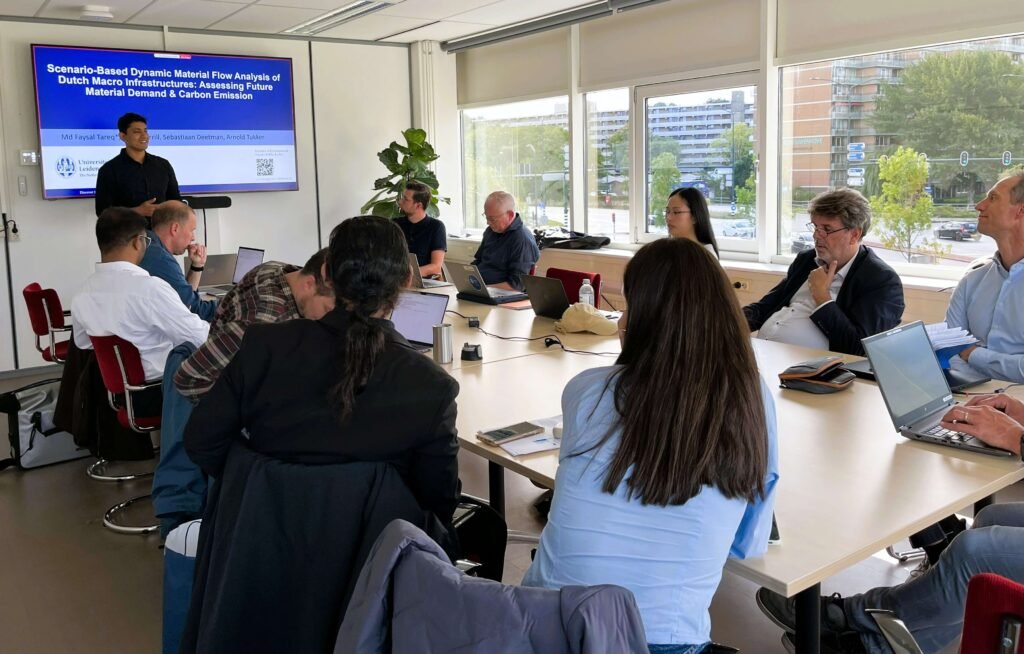
The first presentation was given by Faysal Tareq of Leiden University’s Institute of Environmental Sciences (CML). His research focuses on the dynamic material flow analysis (dMFA) of Dutch macro infrastructures – a term that covers the country’s extensive network of bridges, viaducts, roads, waterworks, pipelines, energy installations, and utilities. Tareq presented results from his bottom-up material stock accounting and scenario-based projections. His work quantifies the bulk materials embedded in Dutch infrastructure (steel, concrete, asphalt), their historical development since the 1950s, and potential future trajectories up to 2070.

SUBLIME
Key findings include:
  • The Netherlands has one of the densest macro-infrastructure systems globally, with infrastructure growth peaking in the 1960s–70s.
  • Future material demand is shaped by contrasting trends: declining oil and gas infrastructure, but rapid expansion in renewable energy systems such as wind turbines and solar installations.
  • Four scenarios (Business as Usual, Pessimistic, Optimistic, Realistic) show that overall steel demand remains relatively stable, with growth in some sectors offset by efficiency gains and reduced material intensity in new designs.
  • Recycling potential is high – up to 80% of demand could be met from secondary materials – but technical barriers and downcycling (e.g. concrete reused as road base) remain significant.
  • Associated carbon emissions from steel production represent a major challenge. While current calculations use European average emission factors, the transition to hydrogen-based production could halve or even eliminate much of this footprint in the coming decades.

The presentation sparked an active discussion with consortium members, particularly around the implications of shifting production technologies, the limitations of average emission factors, and the opportunities for collaboration with steel producers to refine assumptions.

Circular Strategies in Practice – Presentation by Mic Barendsz

Next, Mic Barendsz from Bouwen met Staal (BmS) gave a talk titled “Towards Greener Steel: Re-use, renovation and other design strategies for Circular Civil Works.” His contribution grounded the discussion in practical design and reuse strategies that the Dutch steel construction sector is developing to advance circularity.

Barendsz presented market data on steel tonnages in Dutch infrastructure and highlighted the relatively low proportion of steel currently re-used in civil works, compared with recycling. He presented the R-ladder of circular strategies – ranging from rethinking and re-use, to remanufacturing, refurbishment, and repurposing. A series of project examples illustrated the potential:

  • Repurposing of the Vianen Arch Bridge into housing and public pavilions (design not executed).
  • Remanufacture of HE900B beams for new road bridges.
  • Refurbishment of existing bridges to extend their service life, such as the relocation of bridge sections of movable and fixed bridges.
  • Direct re-use of sheet piles and structural elements guided by the new standard NTA 8713.

He also addressed the environmental impacts of different steel production pathways. Traditional blast furnace production emits 2.25–2.8 tonnes of CO₂ per tonne of steel, whereas electric arc furnace production using scrap can reduce this to 0.6–0.8 tonnes. Hydrogen-based processes may eventually lower emissions to near zero, as well as the previously mentioned re-use, refurbishment, remanufacture and repurposing.

The message was clear: circular design and re-use strategies are critical, but must be combined with innovation in green steel production to meet climate targets.

The Workshop – Rethinking Steel Infrastructure as Socio-Technical Systems

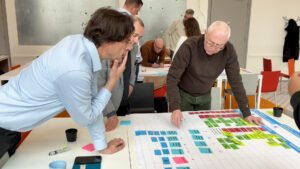
The afternoon was devoted to an interactive workshop led by Dr. Mohammad B. Hamida (TU Delft), based on his research on governance and actor-network theory. His approach views steel infrastructures not merely as technical assets, but as socio-technical systems shaped by multiple interdependent dimensions – technical, environmental, economic, legal, managerial, and social.

The workshop unfolded in three phases:

  1. Problem Definition – participants identified challenges hindering the sustainable and reliable operation of steel infrastructures. Technical issues such as corrosion and fatigue were raised, but also uncertainties in inspection methods, budget constraints, and the growing impact of climate change (e.g. heat waves affecting movable bridges).
  2. Practice Exploration – through group discussions and collaborative use of digital tools, participants mapped key stakeholders in governance and operation, from asset owners and contractors to regulators, shipping companies, and end-users. The exercise highlighted the complexity of overlapping roles and responsibilities, as well as gaps in data and long-term planning.
  3. Solution Identification – participants proposed strategies ranging from technical innovations (non-destructive testing, load reduction measures, improved refurbishment practices) to policy and managerial interventions (better inventory systems, clearer contracts, adaptive regulations, subsidies for circular practices). Environmental strategies such as modal shifts in transport and promotion of cycling were also discussed.

The workshop provided a valuable space for dialogue between researchers and practitioners. As one participant noted, “Research and practice come together here, giving us new perspectives.”

Conclusions and Outlook

The WP3 progress meeting and workshop demonstrated the strength of combining quantitative material flow and LCA analysis, practical design and reuse strategies, and socio-institutional perspectives. Together, these approaches shed light on the multiple pathways toward more sustainable and reliable steel infrastructures in the Netherlands and beyond.

Looking ahead, the insights from this meeting will feed into upcoming WP3 deliverables, including scenario-based LCA studies, governance recommendations, and integration with technical findings from WP1 and WP2. The discussions also reinforced the importance of close interaction between academia, industry, and government stakeholders, ensuring that research outcomes remain relevant and actionable.

With the next project milestones approaching, the consortium is well-positioned to translate these findings into concrete recommendations for policy and practice, helping to realise the overarching SUBLIME ambition: sustainable and reliable macro steel infrastructures for future generations.

Dissemination

CT de Boer Showcases SUBLIME Fieldwork at the 2025 M2i Conference

During the 2025 M2i Conference at Papendal, Anton Gorter of Civiele Technieken de Boer presented the progress of SUBLIME’s field monitoring work on the Van Hall Bridge in Amsterdam. His talk, “An on-site measurement campaign – it sounds so simple” highlighted the many practical steps and unforeseen challenges involved in collecting high-quality strain data on a historic movable steel bridge.

Read More »
Dissemination

Sheet Pile Corrosion Study Begins

The SUBLIME project is taking a major step forward in understanding how steel sheet piles age in real port conditions. In close collaboration with North Sea Port (NSP), TU Delft researcher Prasaanth Ravi Anusuyadevi is preparing the installation of a new field-testing structure that will allow long-term monitoring of corrosion processes on S355 steel.
Following recent discussions between TU Delft and NSP, both partners agreed to install a dedicated sample-carrying structure directly in the port. The design includes three identical frames, each hosting nine steel samples and each intended for different exposure durations: 3 months, 6 months and 1 year. The samples will be positioned at different depths along the waterline to capture how corrosion varies from splash zone to full immersion.

Read More »
Dissemination

Smarter Cameras from Fewer Views — A Sparse-View Pose Estimation

How do you recreate a 3D scene using just a few pictures from different angles? That’s a challenge many fields face — from drone-based inspections to 3D mapping for remote sensing or structural health monitoring. Qingyu Xian, PhD researcher at the University of Twente, is tackling this challenge head-on in the SUBLIME project with a novel tool that’s already showing strong results: the T-Graph module.

Read More »

Leave a Comment

Your email address will not be published. Required fields are marked *

Scroll to Top