
SUBLIME

Understanding Corrosion to Prolong the Life of Steel Sheet Piles: SUBLIME Consortium Meeting Update

LinkedIn
Email
Twitter
Telegram
WhatsApp

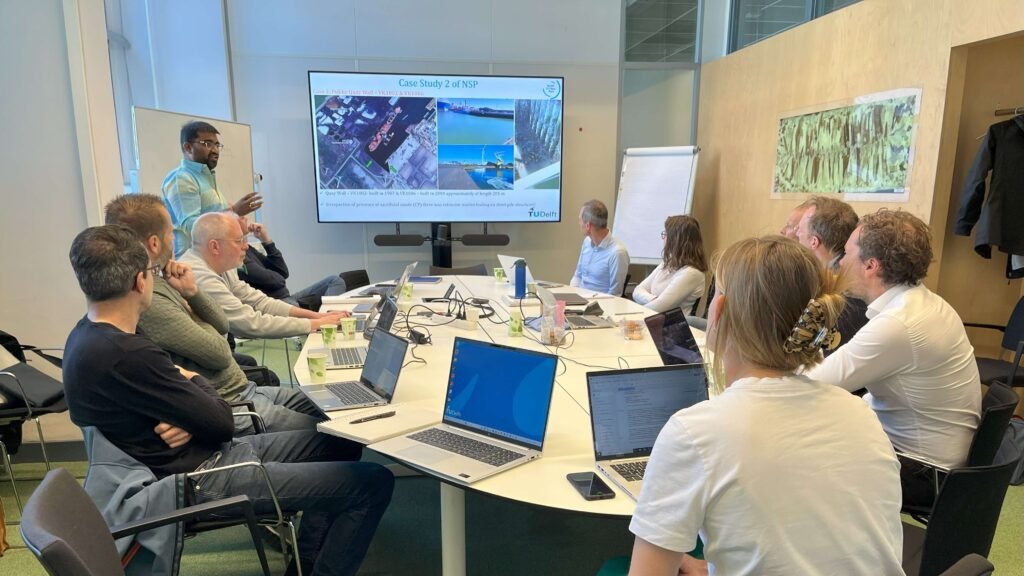
On May 9th, partners of the SUBLIME project gathered  at  Materials Science and Engineering (MSE) Department at TU Delft, to discuss progress and current challenges in monitoring and modelling corrosion in steel sheet pile structures. The session brought together a group of experts from TU Delft, TU Eindhoven, RHDHV, Province of South Holland (PZH), North Sea Port (NSP) and other key stakeholders (M2i and NWO), all committed to increasing the durability and reliability of Dutch infrastructure.

Corrosion in Focus: A Shared Challenge

The meeting focused on two distinct regions: the North Sea Port, where sheet piles are over 20 years old and protected by sacrificial anodes, and PZH, where newer structures (around 6–7 years old) rely on Impressed Current Cathodic Protection (ICCP). In the first case, despite these cathodic protection systems, significant corrosion has been detected, especially in the low-water and tidal zones—areas due to  suspected microbial induced activity. International case studies from the UK, Spain and Japan confirm that this issue is widespread.

Monitoring Gaps and Technological Opportunities

Currently, inspection routines include visual checks above water level (2–3 times annually) and diver-based thickness measurements below water roughly less frequently. However, the last recorded comprehensive data set dates back to 2017 for NSP. To bridge this gap, the team is exploring advanced methods such as drone inspections, satellite imaging and modern sensors. These tools promise more frequent, safer and non-contact ways to assess the condition of sheet piles.

A New Modelling Approach

A core ambition of the SUBLIME project is to develop predictive Digital Twins that integrate both structural models and data. During the meeting, researchers outlined a two-step modelling strategy: (1) translating corrosion into deformation and (2) assessing how deformation accelerates failure. This iterative method will rely on a Bayesian framework to manage uncertainties and perform simulations using a reduced set of key parameters. The ultimate goal is to better predict remaining service life and guide timely maintenance.

Real-World Case Studies Highlight Urgency

TU Delft researcher Prasaanth Ravi Anusuyadevi presented updates on selected study sites:

  • Provincial road N211, completed in 2018, will serve as a baseline because no corrosion measurements have yet been carried out. An initial inspection round is being scheduled.
  • Quay walls VK0805, VK1002 and VK1006 (North Sea Port) have been identified as early adopters for the modelling workflow. Localised thinning and marine growth have been mapped and cathodic‑protection performance is being assessed.

Next Steps

The team agreed on a clear path forward:

  • Prioritize North Sea Port for detailed modelling.
  • Consolidate material data and confirm initial conditions for model calibration.
  • Prepare for the deployment of sensors and new inspection rounds.
  • Develop a finite element model of the structure, accounting for multiple runs with uncertain variables.
  • Involve structural engineers to refine uncertainty estimations.

The next consortium meeting is scheduled for July 7th, from 15:30 to 17:00 (online).

By improving how we assess and predict the performance of steel infrastructure, SUBLIME continues to support the transition toward safer, more sustainable and circular asset management in the Netherlands.

Dissemination

CT de Boer Showcases SUBLIME Fieldwork at the 2025 M2i Conference

During the 2025 M2i Conference at Papendal, Anton Gorter of Civiele Technieken de Boer presented the progress of SUBLIME’s field monitoring work on the Van Hall Bridge in Amsterdam. His talk, “An on-site measurement campaign – it sounds so simple” highlighted the many practical steps and unforeseen challenges involved in collecting high-quality strain data on a historic movable steel bridge.

Read More »
Dissemination

Sheet Pile Corrosion Study Begins

The SUBLIME project is taking a major step forward in understanding how steel sheet piles age in real port conditions. In close collaboration with North Sea Port (NSP), TU Delft researcher Prasaanth Ravi Anusuyadevi is preparing the installation of a new field-testing structure that will allow long-term monitoring of corrosion processes on S355 steel.
Following recent discussions between TU Delft and NSP, both partners agreed to install a dedicated sample-carrying structure directly in the port. The design includes three identical frames, each hosting nine steel samples and each intended for different exposure durations: 3 months, 6 months and 1 year. The samples will be positioned at different depths along the waterline to capture how corrosion varies from splash zone to full immersion.

Read More »
Dissemination

Smarter Cameras from Fewer Views — A Sparse-View Pose Estimation

How do you recreate a 3D scene using just a few pictures from different angles? That’s a challenge many fields face — from drone-based inspections to 3D mapping for remote sensing or structural health monitoring. Qingyu Xian, PhD researcher at the University of Twente, is tackling this challenge head-on in the SUBLIME project with a novel tool that’s already showing strong results: the T-Graph module.

Read More »

Leave a Comment

Your email address will not be published. Required fields are marked *

Scroll to Top