SUBLIME annual meeting

SUBLIME Project Explores Structural Reliability and Innovation at 2nd Annual User Committee Meeting

LinkedIn
Email
Twitter
Telegram
WhatsApp

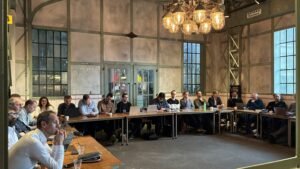
On March 21, 2025, the SUBLIME project consortium gathered for its 2nd Annual User Committee Meeting. Hosted by North Sea Port (NSP) at its Vlissingen premises, the meeting brought together over 30 representatives from research institutions, industry partners, government bodies, and funding agencies to reflect on progress, share research outcomes and explore pathways for future collaboration.

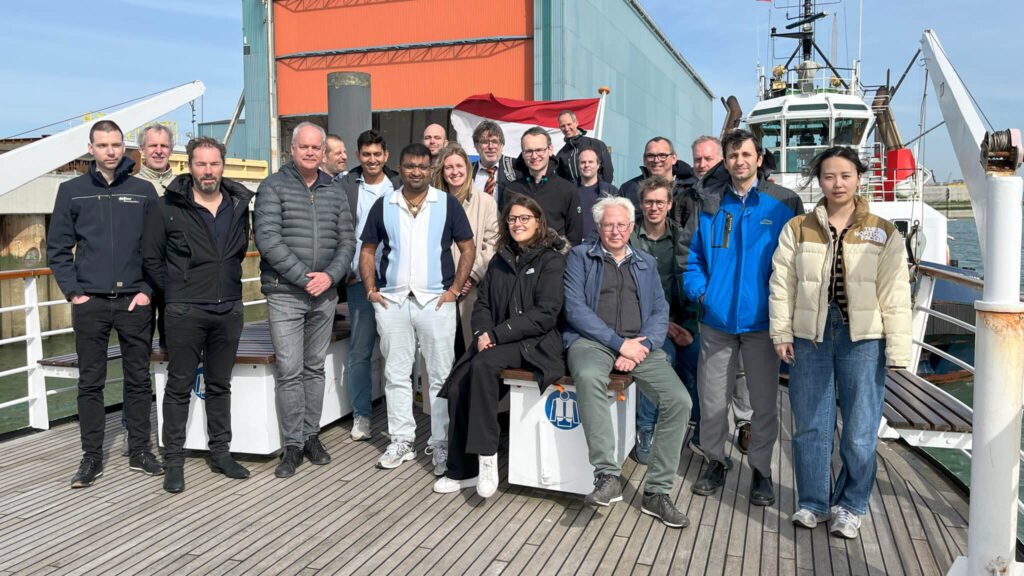
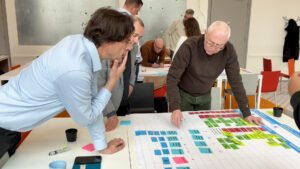
The day featured presentations from PhD and EngD researchers, discussions on key user cases and a site-specific boat tour through the North Sea Port, highlighting the real-world relevance of the project’s themes—fatigue, corrosion, digital monitoring and infrastructure sustainability.

Welcoming Remarks from North Sea Port

Peter Adriaanse (NSP) opened the meeting with a warm welcome and introduced the group to the port’s operations. North Sea Port is a cross-border port area spanning 60 kilometers along the Dutch-Belgian coast, encompassing Vlissingen, Terneuzen and Ghent. The port region is home to over 525 companies and plays a central role in Europe’s industrial and logistics networks—handling approximately 70 million tons of goods annually and supporting sectors like steel, chemicals, energy and construction.

With many steel sheet piles and port structures subject to marine corrosion and long-term degradation, the port’s infrastructure is highly relevant to the SUBLIME research themes. NSP’s contribution as a use case provider underscores the mutual benefit of this collaboration between science and practice.

Highlights from Research Presentations

The morning session featured updates from multiple work packages (WPs), beginning with Elena Zancato (TU/e) from WP1. Elena presented her progress on fatigue life prediction of steel bridge components, emphasizing a probabilistic approach that includes material uncertainties and inspection data. Her model integrates Bayesian updating techniques and accounts for the impact of inspection methods—ranging from advanced tools like TOFD to conventional visual checks. Elena also outlined how her work connects with WP2 (digital twin platform) and WP3 (sustainability and policy), laying the groundwork for a truly integrated assessment framework.

Next, Prasaanth Ravi Anusuyadevi (TU Delft) presented corrosion-related work under WP1. He described field studies and data analysis of steel sheet piles in marine environments provided by South Holland Province (PZH) and North Sea Port (NSP). His presentation revealed different corrosion protection strategies (e.g. impressed current vs. sacrificial anodes) and identified common degradation patterns. The goal is to build predictive models for sheet pile deterioration and link those models to structural safety assessments.

Of special interest were the user cases involving sheet piles with significant marine fouling. Gerard Verburg (NSP) supported the field inspections, offering essential insights into the real conditions. These findings will guide future simulations and potential follow-up inspections.

Afternoon Focus: Digital Twins and Environmental Impact

Following a networking lunch and scenic boat tour through the North Sea Port, the afternoon sessions shifted to WP2 and WP3.

Qingyu Xian (University of Twente) introduced her novel 3D vision-based vibration monitoring method using drone imagery. Her system estimates natural frequencies and modal shapes of bridge structures with minimal intrusion, offering a promising complement to traditional sensors. She also introduced “T-Graph,” a lightweight enhancement module that improves camera pose estimation—crucial for drone-based inspection accuracy.

Ali Sabzi Khoshraftar (University of Twente), an EngD researcher, presented the architecture of the digital twin platform he is developing. Using a case study of the Tankinkbrug, he showed how digital twins can reduce inspection time, enhance accuracy and inform better asset management decisions. His work integrates simulation environments, virtual reality (VR), and artificial intelligence (AI) tools to modernize infrastructure inspections.

Ali’s findings sparked interest in organizing a hands-on demonstration workshop. Plans were made for a stakeholder session in May 2025 to showcase the prototype and explore how engineering firms could integrate such platforms into their workflows.

WP3: Quantifying Infrastructure and Emissions

Faysal Tareq (Leiden University) wrapped up the research presentations with insights from WP3. His work quantifies the material stock and environmental impact of Dutch macro infrastructure using GIS-based material flow analysis. Faysal’s analysis revealed that the Netherlands has one of the highest concentrations of steel and concrete infrastructure in the world—particularly in urban regions like Zuid-Holland and Noord-Holland.

His ongoing work connects infrastructure material data with lifecycle assessments (LCAs) to estimate future CO₂ emissions and explore the trade-offs between extending the life of existing assets versus building new ones. Faysal’s collaboration with WP1 and WP2 will assess how innovations like digital twins and fatigue monitoring affect sustainability outcomes.

Real-World Connection: Boat Tour in Vlissingen

A highlight of the day was the boat tour through the Vlissingen section of North Sea Port. Led by Gerard Verburg, participants had the opportunity to observe key port assets—including several sheet pile walls featured in the project’s corrosion studies.

Gerard pointed out various types of corrosion protection systems in use and discussed how tidal action, marine fouling, and ship traffic influence degradation rates. This firsthand view helped bridge the gap between academic models and practical engineering challenges, emphasizing the importance of integrating on-site data into prediction frameworks.

The tour underscored the vital role of steel infrastructure in keeping ports operational and competitive, and demonstrated why efforts to monitor, maintain, and modernize these assets are crucial for the Dutch economy and global trade flows.

Planning and Next Steps

The meeting concluded with administrative updates and planning for the coming year. Key announcements included:

  • Upcoming Meetings: WP1, WP2, and WP3 meetings are scheduled between May 2025 and January 2026, with a focus on deepening collaboration around selected use cases.
  • Digital Twin Workshop: Scheduled for May 23, 2025, location: RWS, Utrecht. This session will bring together engineering firms, steel producer, asset owners and academic partners to review and test Ali’s digital twin platform.
  • Next Annual Meeting: To be hosted by ProRail in March 2026, with TNO identified as the prospective host for 2027.

Looking Ahead

The 2nd Annual User Committee Meeting showcased not only impressive research progress but also a strong spirit of collaboration among academic and industry partners. As the project moves into its application and integration phase, all signs indicate that SUBLIME is on course to deliver both technical innovation and societal impact.

From the waters of North Sea Port to the bridges of Amsterdam, SUBLIME continues to chart a path toward safer, smarter and more sustainable steel infrastructure.

Project participants are grateful to North Sea Port and particularly to Gerard Verburg and Inge De Rouck for meeting organization and hosting.

Dissemination

CT de Boer Showcases SUBLIME Fieldwork at the 2025 M2i Conference

During the 2025 M2i Conference at Papendal, Anton Gorter of Civiele Technieken de Boer presented the progress of SUBLIME’s field monitoring work on the Van Hall Bridge in Amsterdam. His talk, “An on-site measurement campaign – it sounds so simple” highlighted the many practical steps and unforeseen challenges involved in collecting high-quality strain data on a historic movable steel bridge.

Read More »
Dissemination

Sheet Pile Corrosion Study Begins

The SUBLIME project is taking a major step forward in understanding how steel sheet piles age in real port conditions. In close collaboration with North Sea Port (NSP), TU Delft researcher Prasaanth Ravi Anusuyadevi is preparing the installation of a new field-testing structure that will allow long-term monitoring of corrosion processes on S355 steel.
Following recent discussions between TU Delft and NSP, both partners agreed to install a dedicated sample-carrying structure directly in the port. The design includes three identical frames, each hosting nine steel samples and each intended for different exposure durations: 3 months, 6 months and 1 year. The samples will be positioned at different depths along the waterline to capture how corrosion varies from splash zone to full immersion.

Read More »
Dissemination

Smarter Cameras from Fewer Views — A Sparse-View Pose Estimation

How do you recreate a 3D scene using just a few pictures from different angles? That’s a challenge many fields face — from drone-based inspections to 3D mapping for remote sensing or structural health monitoring. Qingyu Xian, PhD researcher at the University of Twente, is tackling this challenge head-on in the SUBLIME project with a novel tool that’s already showing strong results: the T-Graph module.

Read More »

Leave a Comment

Your email address will not be published. Required fields are marked *

Scroll to Top